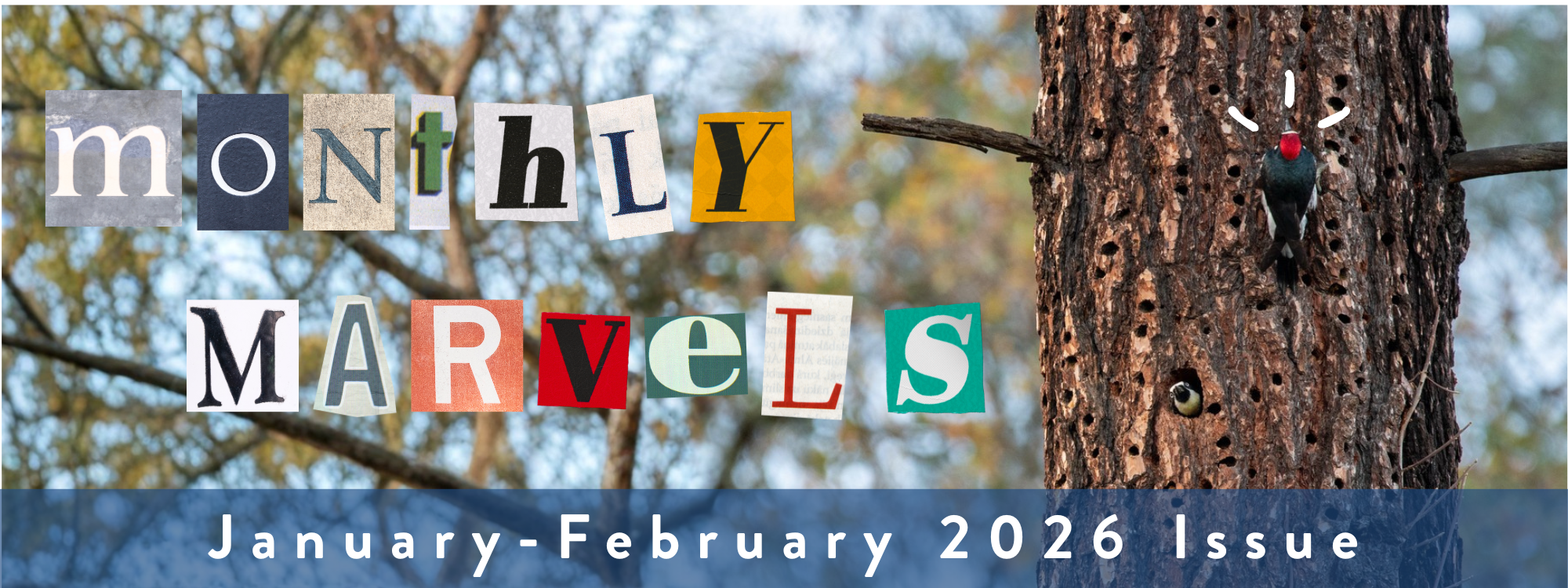
This January and February, the park is bustling with winter happenings of all kinds. Acorn woodpeckers are tending to their granaries, scarlet elf cups are performing their magical spore displays, and sea lemons are busy depositing their crocheted egg masses into Point Reyes tide pools. Start the new year with an adventure to seek out some of these wonders, and discover some winter marvels of your own!
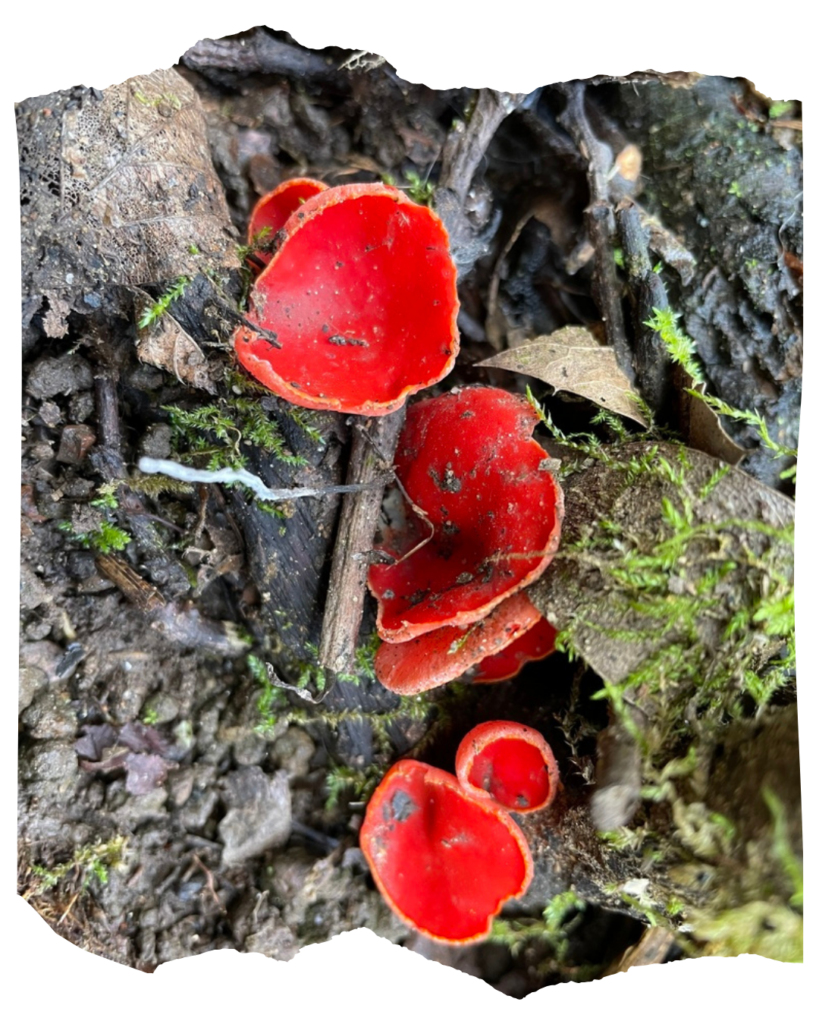
Magical Scarlet Elf Cups
Near the end of the mushroom season—typically emerging in the late wintertime and spring—you might notice scarlet elf cups (Sarcoscypha coccinea) dotting Point Reyes’ forests. Their vibrant red-orange surfaces stand out on the forest floor, and are often initially mistaken for plastic litter or flowers. They grow on decaying hardwood (such as sticks, branches, and stumps), sometimes appearing to emerge right out of the ground if the wood is hidden beneath fallen leaves. As saprobes (the group of fungi that act as decomposers), these mushrooms help to provide nutrients for springtime flora to flourish.
You can encourage the elf cups to perform their magical display; blowing on the mushroom creates a temperature change, triggering thousands of spores to be released from the cup’s inner surface and up into surrounding airways. The tiny spores—only 25-35 micrometers long—are swept throughout the forest, eventually settling down to germinate and employ their decomposing superpowers in a new location. You may also hear the spores being released, which sounds like a short puffing exhalation. This is a fungi of many magical marvels!
Watch a scarlet elf cup’s spore display in action! To spot, visit woodlands in the Seashore which are damp and shaded and scan the landscape for their brilliant hues.
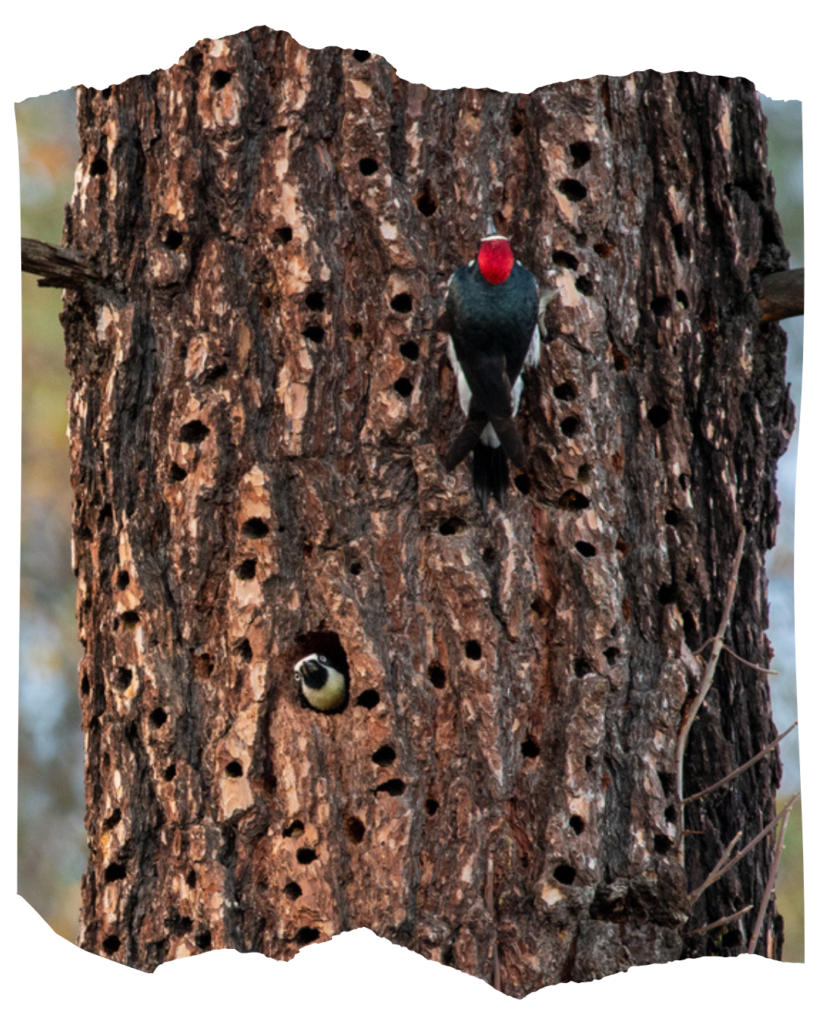
The Drama of Acorn Woodpecker Granaries
This winter, acorn woodpeckers around the Seashore (Melanerpes formicivorus) are eating away at the large stores of nuts which they collected in the fall. Family units work together to drill perfectly-sized holes in wood (think: trees, dead limbs, and even utility poles) to form large granaries. Each hole is perfectly sized for fresh acorns, and the birds diligently move them to smaller holes once they’ve dried out and shrunken. Each granary can store anywhere from hundreds to tens of thousands of acorns, keeping clans well-fed during months when their other food source—flying insects—are more scarce, or for years when oak trees yield fewer acorns.
These granaries aren’t without contention—when acorn woodpeckers inhabiting a sought-out granary die, others from surrounding territories compete to win over the space. These fights are tough and bloody, and competitors battle for up to 10 hours a day over the course of several days. These conflicts are public spectacles—like audience members at the Roman Colosseum, birds leave their territories to watch the murderous drama.
Look out for collections of tightly-packed holes drilled into tree trunks around the Seashore. You’ll likely see acorn woodpeckers with their distinguishable red caps nearby!
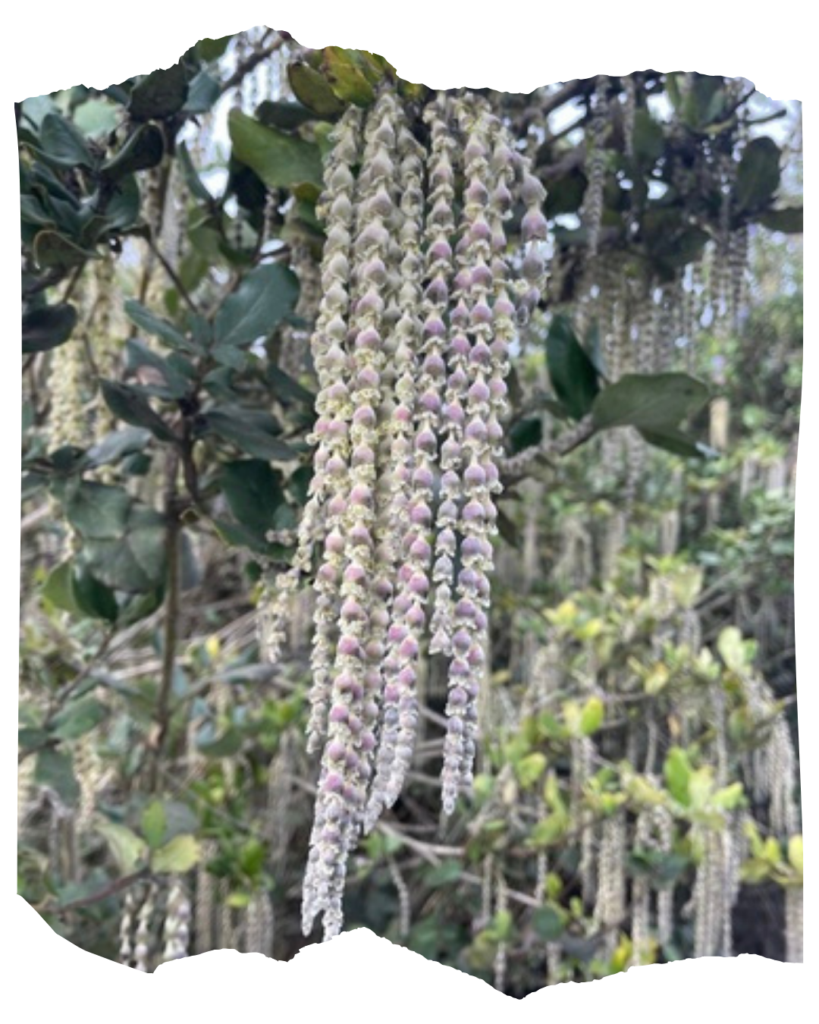
Point Reyes’ Bead Trees
Although we’re in the midst of winter, signs of spring are already emerging! In January and February, long strings of grey-green blooms form on the coast silktassel (Garrya elliptica) decorating these trees like Mardi Gras beads, bearing a resemblance to the Bead Tree at Tulane University. These long clusters of flowers are called catkins; unlike other flowers, which contain both female and male structures, catkins are unisexual. On the coast silktassel, male catkins are longer (about a foot long) and appear grey-green, while female catkins are shorter with a silver-grey coloration. Pollen from the male catkins is released into the wind, landing on the smaller female flowers and prompting them to develop and release seeds.
These winter-blooming flowers provide important food sources for native birds and pollinators when other food sources are scarce. Look out for the coast silktassel around the Seashore’s chaparral and mixed evergreen forests!
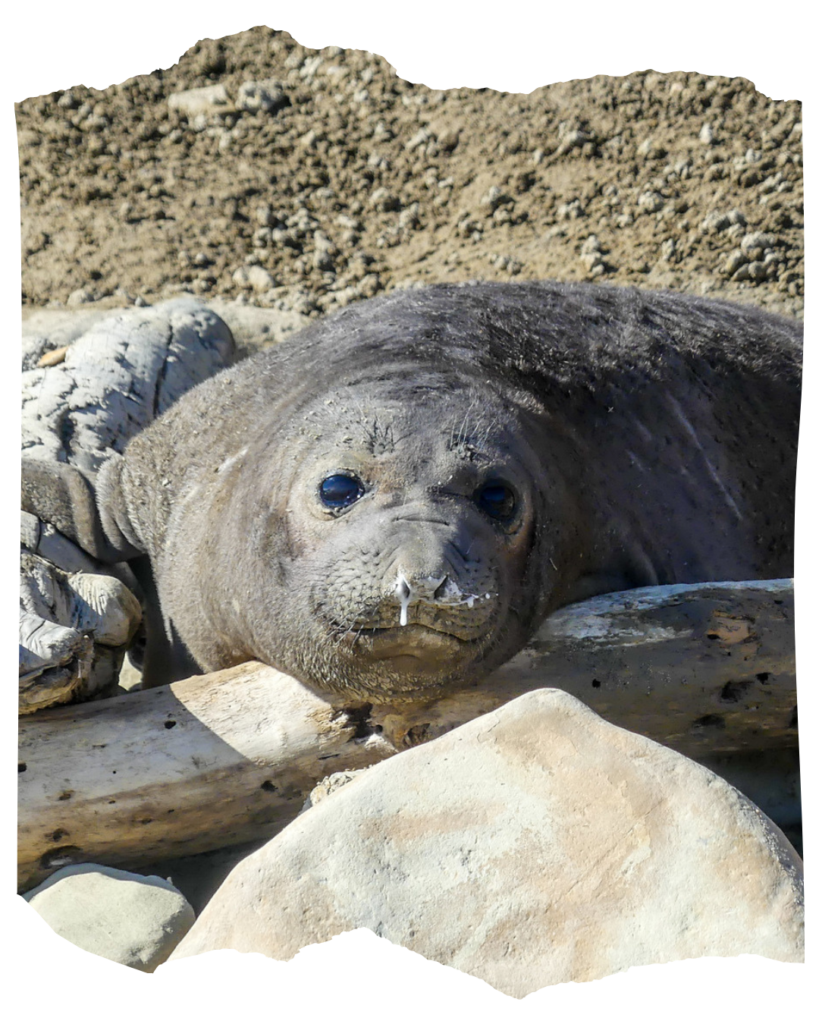
Elephant Seals’ Super Snot
While observing the elephant seal adults and pups lounging at Drake’s Beach, you might notice that many have…well…quite drippy noses.
This white fluid isn’t nasal mucus, but a substance called pulmonary surfactant. All mammals’ lungs, including humans and elephant seals, are lined with this collection of proteins and lipids, essential to our ability to breathe. The “snot” is also key to the seals’ ability to dive more than 5,000 feet into the inky depths of the ocean by acting as an anti-adhesive. As they descend, the seals’ lungs are under an immense amount of pressure. The slippery pulmonary surfactant prevents their lung tissues from sticking together, and allows them to easily re-expand as the seal ascends to the water’s surface.
During their winter breeding season, see elephant seals and their pups at Drakes Beach, the Elephant Seal Overlook at Chimney Rock, or the Point Reyes Lifeboat Station. You’ll likely see a trail of white pulmonary surfactant hanging from their noses!
Crocheted Egg Masses
When tidepooling this winter, keep an eye out for bright yellow or orange blobs—sea lemons (Peltodoris nobilis).
Sea lemons are winter spawners, releasing delicate, intricately-designed egg masses which resemble rolls of light-yellow crocheted ribbon from November to March. These woven wonders are made up of as many as two million eggs, and fewer than 1% of the larvae survive into adulthood. Sea lemons, as well as other nudibranchs, are considered r-selected species—those who produce many offspring, mature quickly, and have short lifespans, as opposed to k-selected species, who have few offspring, mature slowly, and have longer lifespans. They’re also hermaphroditic, and are able to mate with any other sea lemon, also an adaptation to increase their chances of successfully reproducing in their short one-year lifespans.
Visit the tidepools at Sculptured Beach or Duxbury Reef and explore the winter intertidal organisms. You may spot a sea lemon or one of their crochet-like egg masses! Be sure to check the tide tables, tread lightly, and watch for sneaker waves!
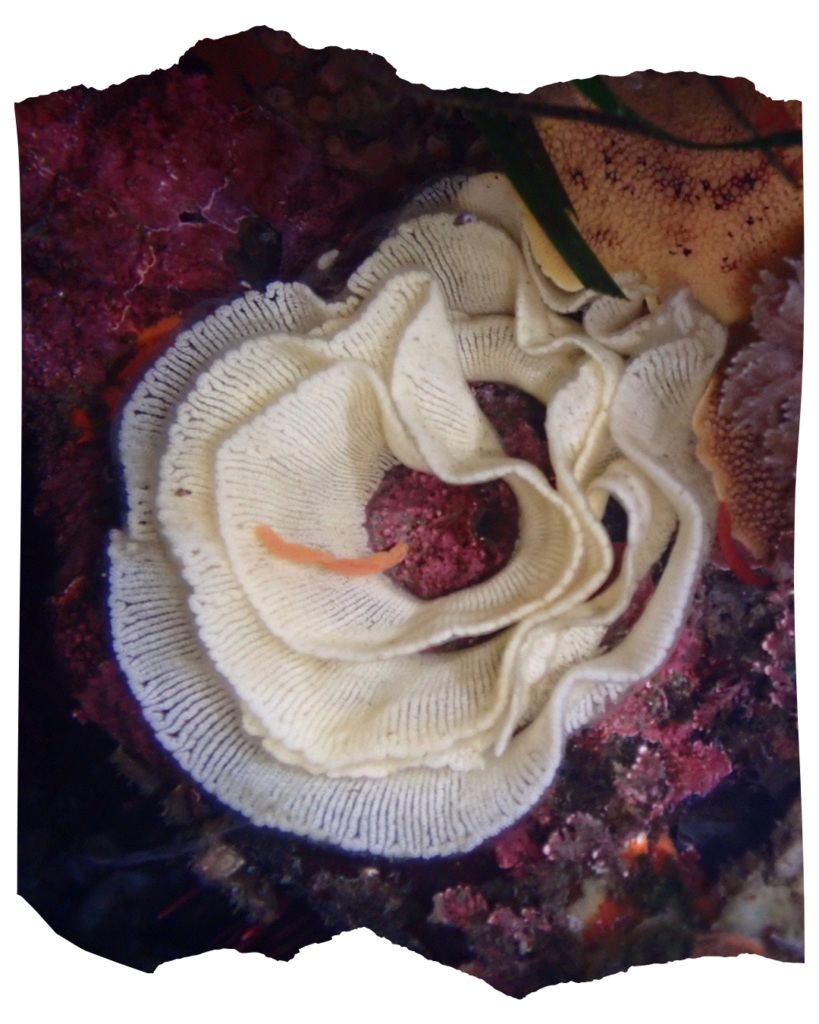
Image Credits: Scarlet elfcups – rscherzer via iNaturalist; Acorn woodpecker – Debra de Leon via iNaturalist; Coast silktassel – michael_c_mahoney via iNaturalist; Elephant seal – NPS / PRNSA / Aiko Goldston – NMFS Permit No. 27424; Sea lemon egg mass – Luan Roberts via iNaturalist