Attention as Care: Rainey Straus’ Collaboration with the Trees of Point Reyes
February 18, 2026__|__Avani Skye Fachon, PRNSA Multimedia Storytelling Coordinator
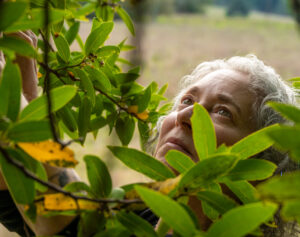
Through paying attention, Rainey Straus is returning to her roots.
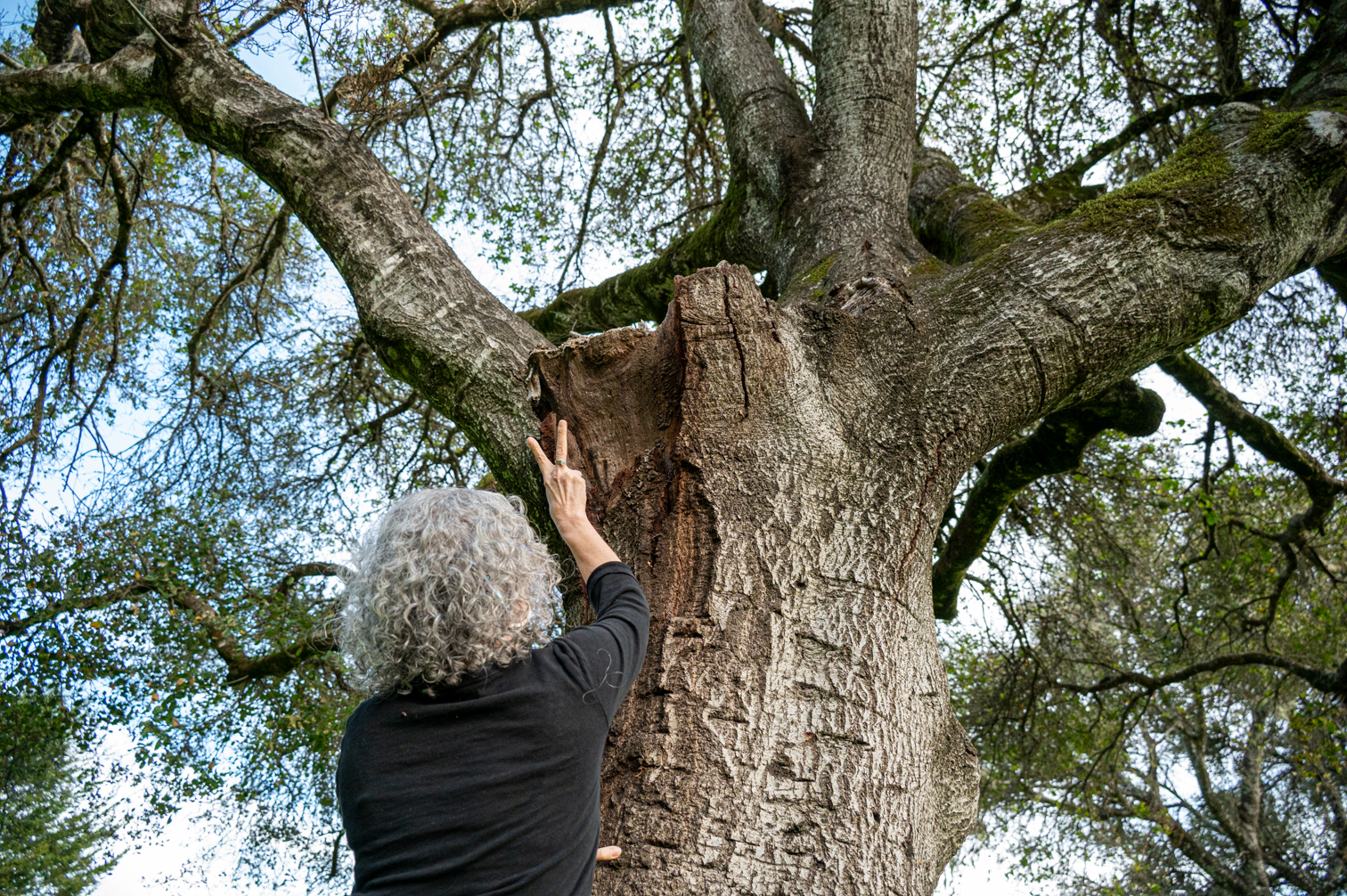
Straus—a Bay Area visual artist—gazes up at a tall oak, her green eyes a reflection of the leaves’ verdant hues. She observes the form of the tree, admiring how the branches diverge from one another, twisting towards the sky. She admires the crooks and crevices which adorn the bark, and the tufts of moss which fill them. Beneath her feet, she feels the energy of the tree’s roots firmly planted in the soil.
As she stands with this deeply rooted oak—and the many others in this arboreal community along Earthquake Trail in Point Reyes National Seashore—Straus is reflecting on her own beginnings. She remembers her first trip to Point Reyes in her early 20s; while taking a Thelma and Louise-style road trip across the country with her best friend, they came across an article about Tomales Point—a peninsula at the northernmost edge of Point Reyes. The pair felt alive as they wandered past the grazing elk and along the wide-open grassy crest, the coasts of Tomales Bay and the Pacific Ocean unfurling on either side of them. Straus, who had a passion for art-making since she was a child, was inspired by the sense of possibility and aliveness which radiated from the land. Here on Earthquake Trail, she reflects back on old photographs from that day in 1986, which she keeps tucked carefully within a small green vintage suitcase:
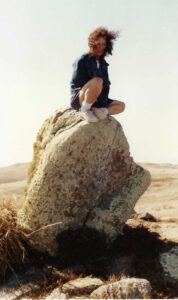
“It’s funny, I have pictures from that hike and I’m like a little sprite on this pile of rocks,” says Straus. “That place has always been really special to me since then.”
A few years later, Straus moved to San Francisco—intrigued by the city’s hippy history and alternative vibe—and came to Point Reyes frequently as a necessary relief from urban life. To support her art-making, she began working in graphic design, and later on, became further immersed in the tech industry as a software designer—a common career trajectory for creative individuals in the Bay Area as the internet grew in the 90s. Over time, as life took over and she visited Point Reyes less often, Straus began to feel increasingly unhappy amidst the constant buzz of screens and tech chatter, and yearned for what felt embodied, real, and alive. These feelings of unrootedness culminated during the pandemic and the 2020 California fires. She realized that in order to generate a sense of groundedness, she needed to return to her roots as an artist.
In 2022, while dreaming of a project that would not only get her away from the computer, but out of the studio, she learned that Meadow Trail—impacted by the 2020 Woodward Fire which burned nearly 5,000 acres of the Seashore’s wilderness—had re-opened.
“I had been really intrigued by spaces that were coming back to life after fires here in Northern California, and I think it actually mirrored my own kind of coming back to life metaphorically,” reflects Straus.
Inspired by her personal connection to this regenerating landscape, Straus began bringing sheets of square, light-sensitive paper on her hikes along Meadow Trail to create cyanotypes—a contact printing technique popularized by early photographer Anna Atkins, who created photograms documenting the intricacies of algae, ferns, and other flora. Atkins placed her floristic subjects directly onto the paper, capturing a detailed imprint of their likeness; Straus used an alternative method, holding the papers up to foliage by hand to capture the forms of light and shadow which danced through the forest. The process was a conversation between Straus’ body, the blackened tree trunks, the re-growing foliage, the sun, wind, and rain—a direct collaboration with this landscape to document its aliveness and resilience. Looking closely at some of the prints, viewers might even spot traces of charcoal from the burned environment.
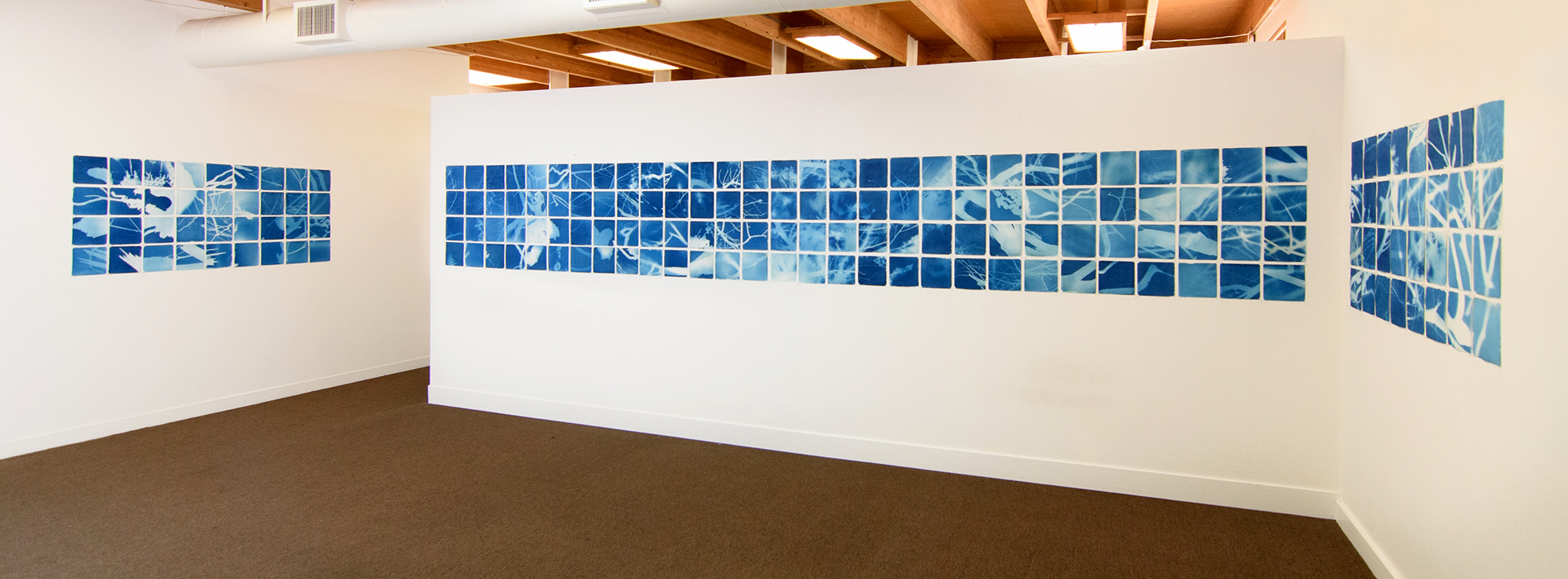
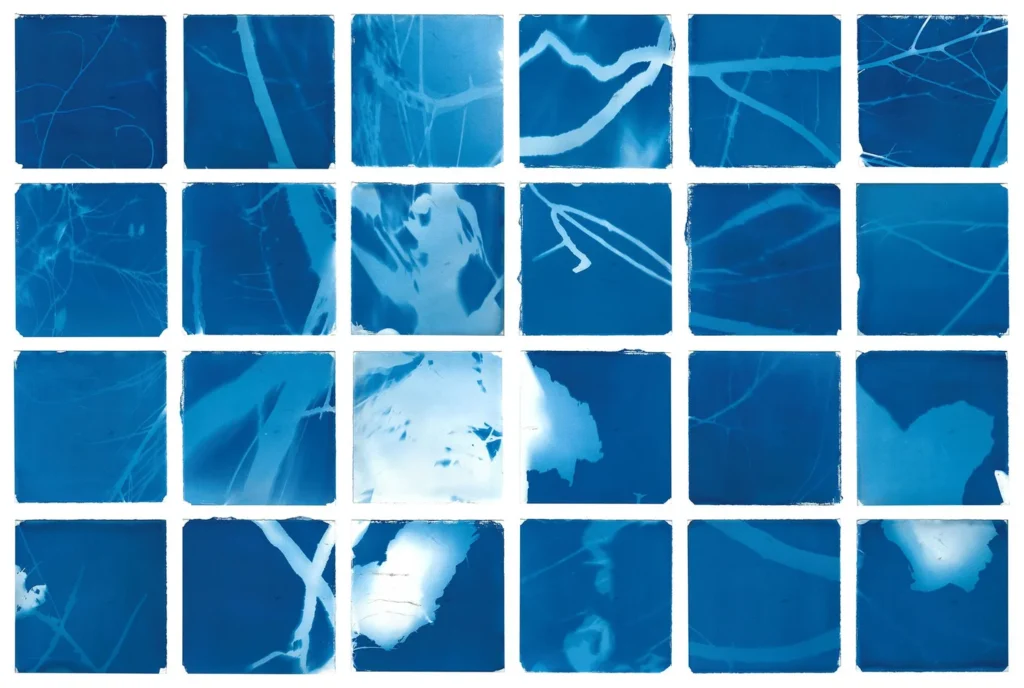
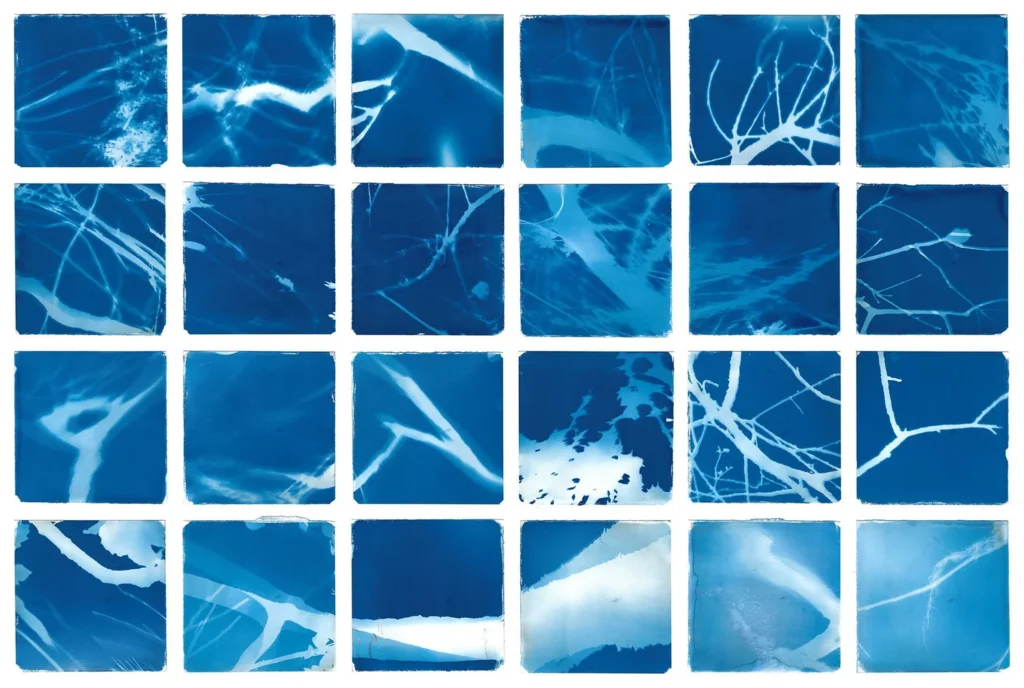
The Meadow Trail: 8 Days Out maps Straus’ time walking along Meadow Trail over multiple seasons impacted by the 2020 Woodward fire. Studio photo by Laurie Bishop.
After each outing to the trail, Straus brought the prints back to her studio: “I would build a composition, weaving these images together that had captured the light and shadow of different plants to create a document or a map of that one day and one place on the trail,” says Straus. The project, titled The Meadow Trail: 8 Days Out, resulted in a series of grids forming a map of the trail over distance and time, a document of the ecosystem’s regeneration—just as Straus was embracing her own personal regeneration.
Recently, Straus has taken her close collaboration with the Seashore’s more-than-human world a step further with her newest project—Spinning Time into Form. Through this work, she questions the conventional view that the human and more-than-human world are separate. She was inspired by feminist theorist and physicist Karen Barad, who challenges notions of subatomic distinction—that every leaf, wildflower, river, or human, for example, are separate entities—suggesting rather, that they are all entangled, interacting, and becoming. These views also parallel Indigenous worldviews which de-center humans, seeing them simply as one of many in the great entanglement of life.
In developing Spinning Time into Form, Straus collaborated with oak and bay trees along Earthquake Trail, and used LiDAR technology as a probe to see the trees from a fresh perspective—from an alternative plane within the vast web of interspecies existence.
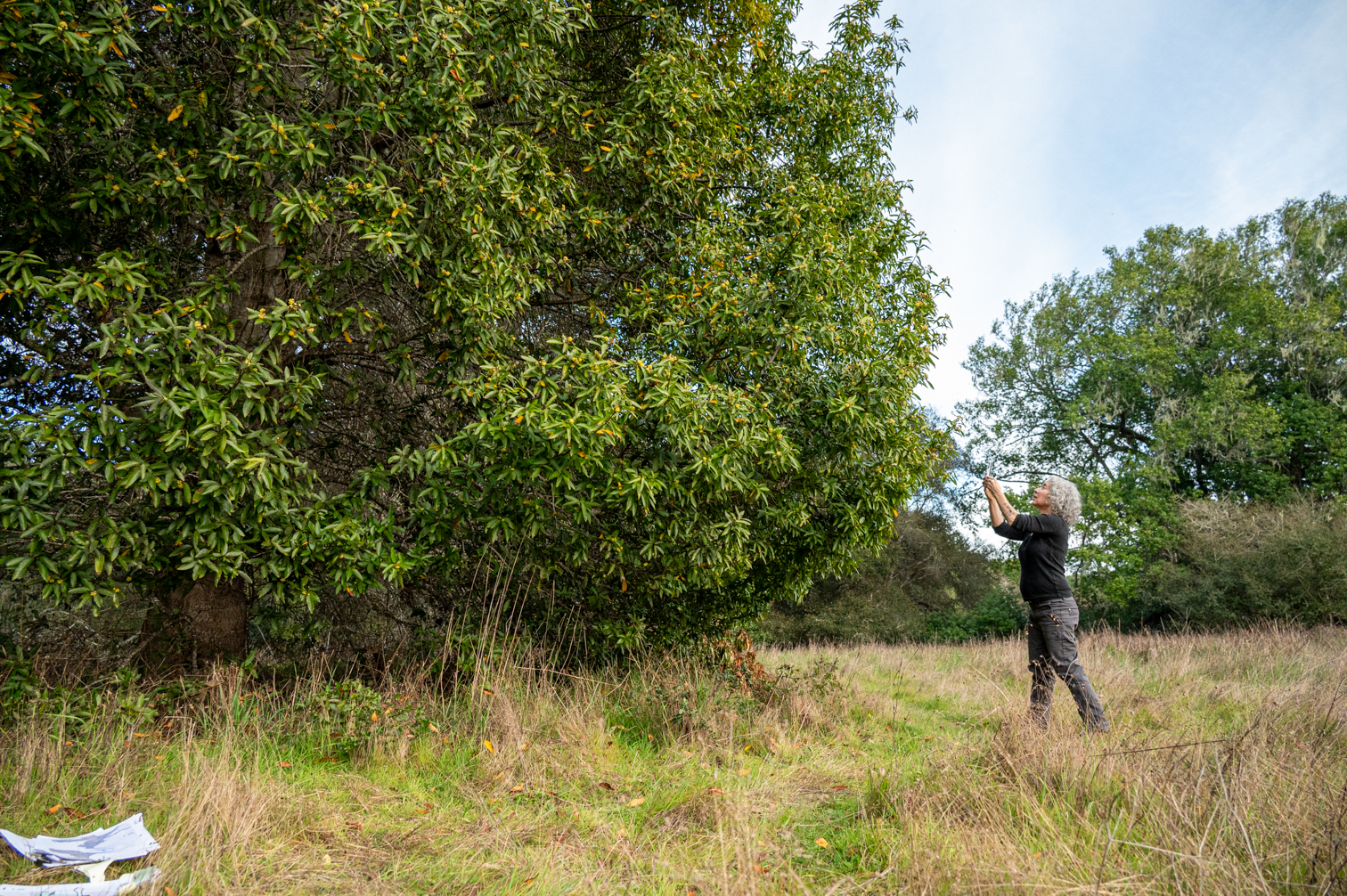
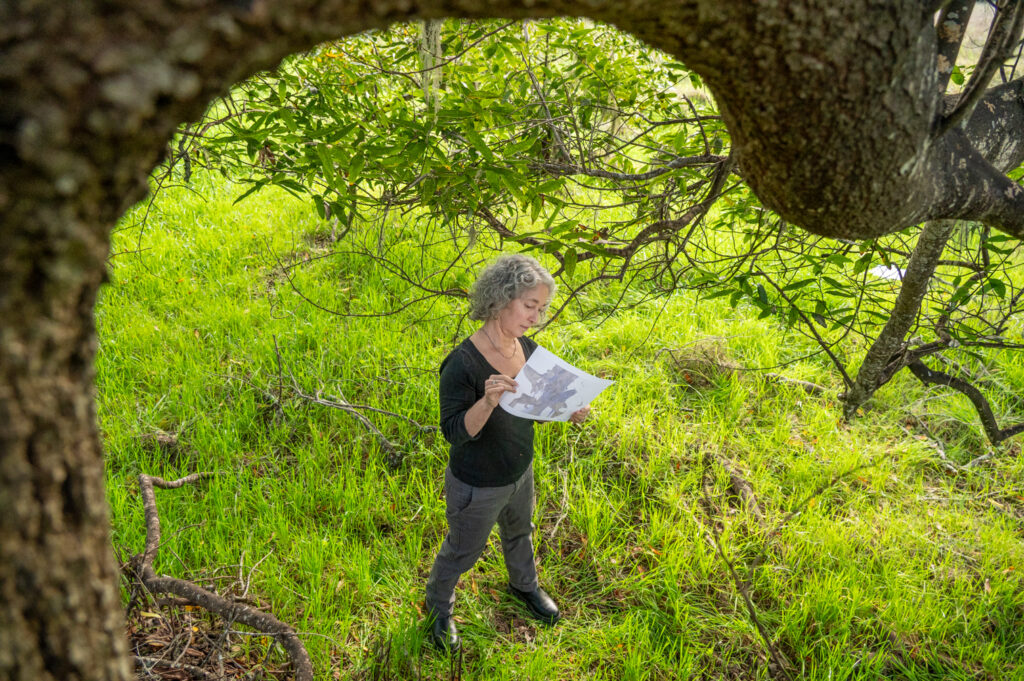
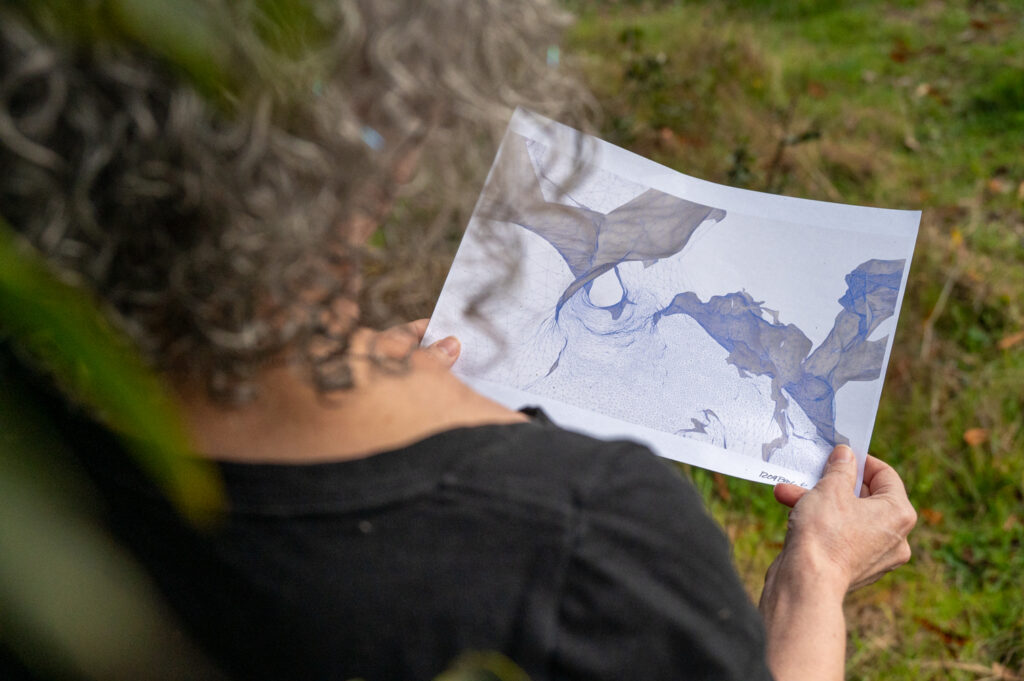
Straus used LiDAR technology to create models of the bay and oak trees along Earthquake Trail. She used this method as a tool to see the trees from a fresh perspective. Photos by PRNSA / Avani Fachon.
“It’s the same way when you learn to draw,” explains Straus. “A lot of times you do a face, but you’re not really looking because you have these assumptions. And for me, I like the LiDAR scanning because it allows me to make a model of the tree. You can really spin it and distort it and see it in motion and see it in a way that is different from my habitual way of seeing.”
Straus output hundreds of still images from these models, and stuck them up on her studio walls, responding to their energetic signatures and crafting armatures out of chicken wire. She carefully covered the models with a heated bioplastic filament—a degradable and plant-based material—peeling them off the wire after they’d hardened, and suspending them into the air.
“Even though they’re static sculptures, there’s something about the aesthetic and the way I’m making that allows you to move in between and among these objects, so you become part of the field,” explains Straus.
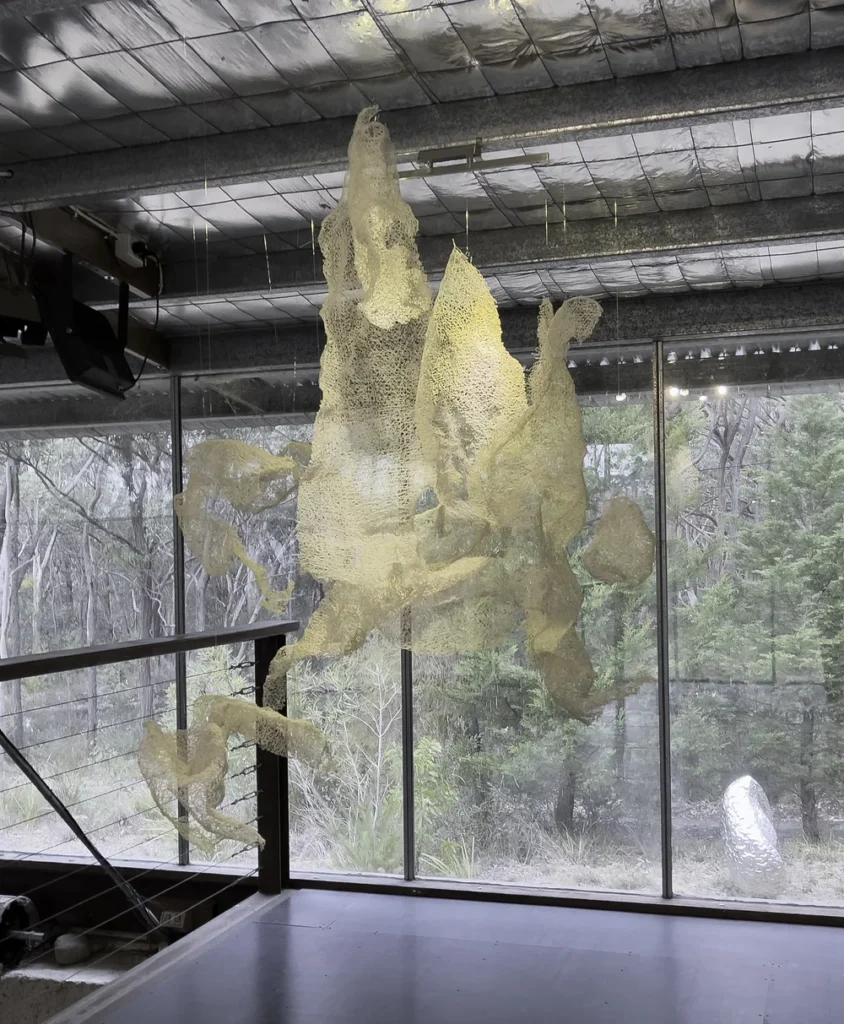
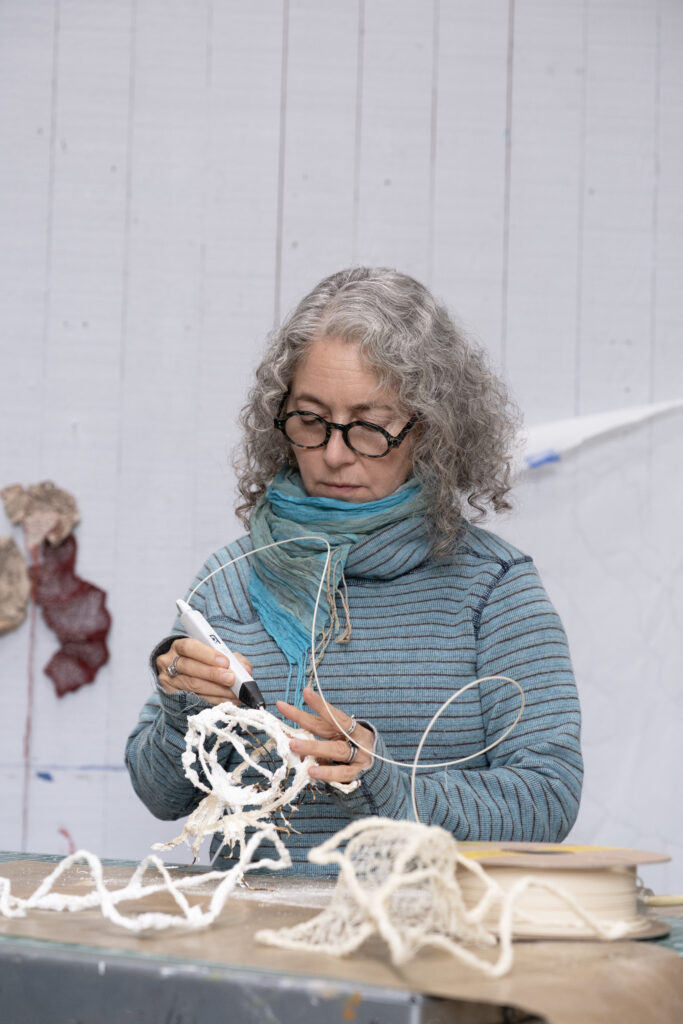
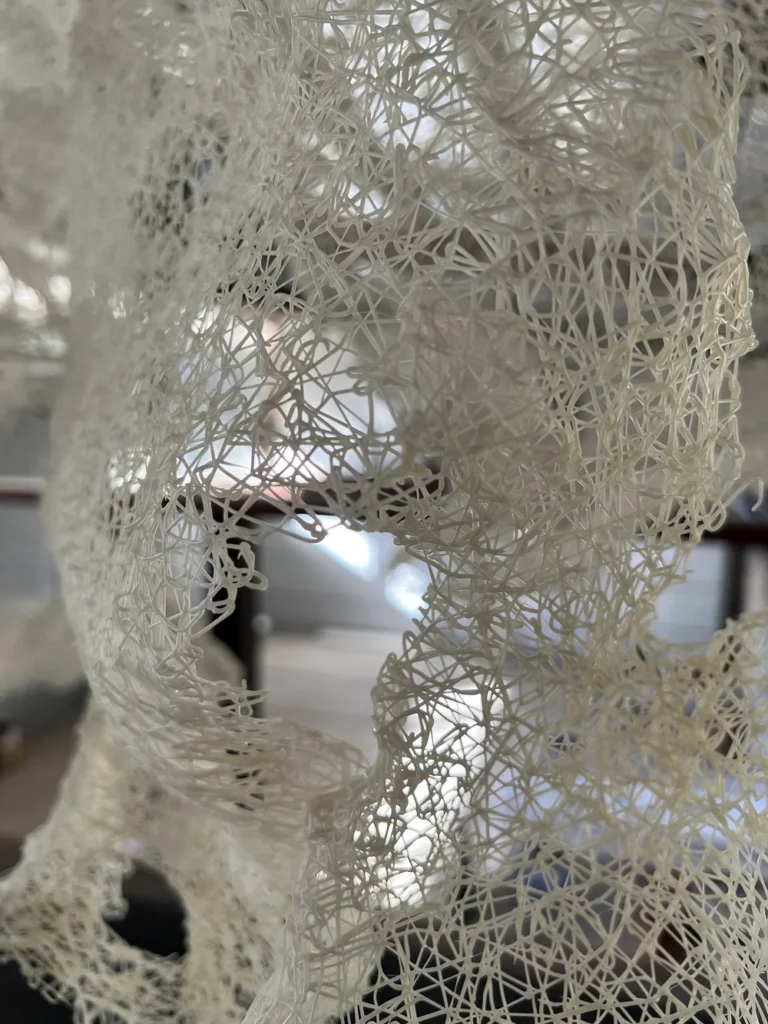
Straus used bioplastic to create ethereal, suspended forms inspired by the energetic signals of trees along Eathquake Trail. Photos of sculptures courtesy of the artist; Rainey at work by Sina Dehghani.
The suspended energetic signatures are paired with seed and fungus-like forms, crafted from papier-mâché, cast paper, cheesecloth, waxed thread, pine needles, and watercolors. By paying attention and taking the time to truly see, Straus has re-rooted her personal relationships with the more-than-human world that she so missed while immersed in the Bay Area tech world, and sprouted the seed of vitality that she felt when she first visited Point Reyes in her early 20s: “[I’m at] a place in my life where what’s deeply important to me is walking on the land and planting things,” says Straus. “And the more I do this work, the more I want to be in relationship with those things.”
She hopes that Spinning into Time will encourage others to pay attention to and rejoice in the marvelous entanglement of our earth, as well.
“We really have a hard time kind of standing up for and protecting the things that we’re not intimate with,” explains Straus. “Attention is a form of care. I try to model that attention…I would really like my viewer to experience their own version of that with their own places.”
Rainey Straus’ exhibit, Spinning Time into Form, is on view starting March 7th at Route One Gallery, accompanied by a dawn chorus recorded at the Seashore by sound recordist Mark Lipman. On April 11, join us for a walk-and-listening event along Earthquake Trail to tune into the trees with which Straus collaborated, followed by a reception at Gallery Route One.