Where Two Floras Meet: Point Reyes Through Plant Pigments Inspired by Emily Dickinson’s Herbarium
Anthotypes by Leah Sobsey and Amanda Marchand | Words by Avani Skye Fachon | Point Reyes National Seashore Association
From Dickinson’s herbarium cased in green cloth to a tiny purple flower blooming in Point Reyes’ dunes, the touch of seemingly distant realities is incredible, indeed.
A fascinating phenomenon plays out in our world: lived realities continuously travel over time and space, touching and interacting with each other in interesting ways. It’s possible—along one of these infinite pathways—for Emily Dickinson’s 19th century world of herbaria to meander across centuries and coasts, eventually brushing against two artists and one tiny endangered species sprouting in Point Reyes’ sandy dunes.
It’s 2026, and preserved in a vault deep within Harvard University’s Houghton Library sits an old book cased in floral green cloth and gold foil: Emily Dickinson’s herbarium. The 66-page book contains pressings of 424 specimens, and Dickinson’s looping handwriting carefully labels each one—Rubus, odoratus; Viola, tricolor; Apocynum, androsaemifolium.
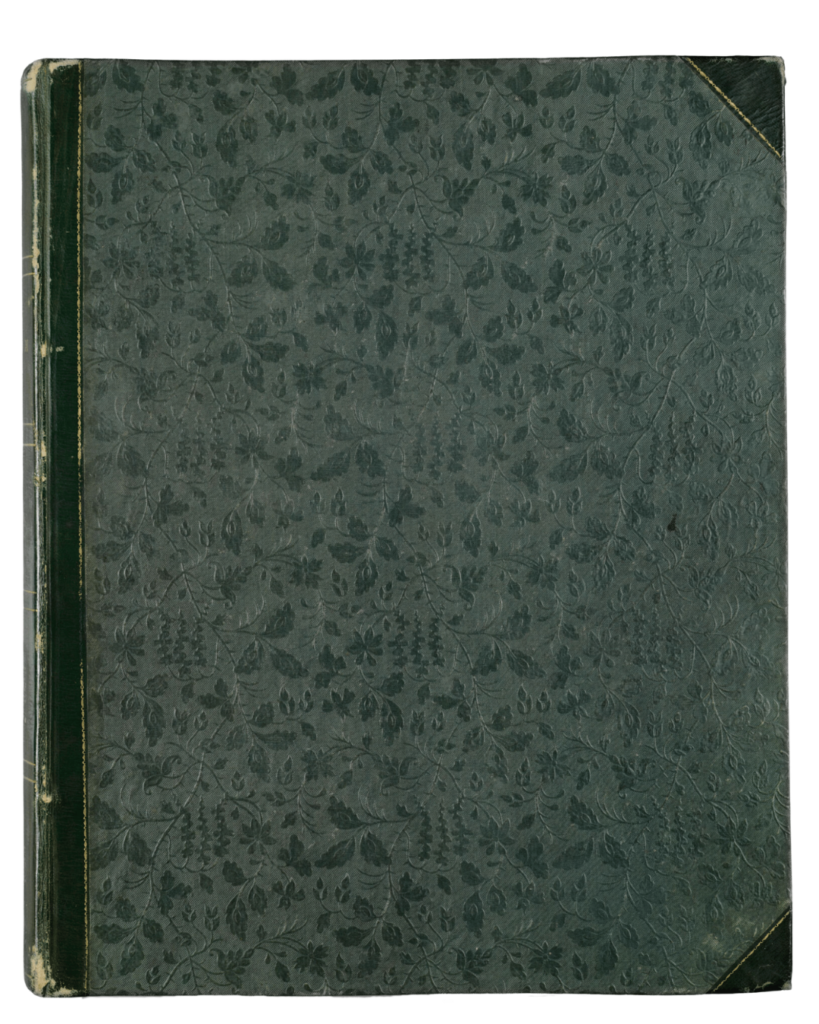
Dickinson’s herbarium. Image courtesy of Harvard Library.
Many know Dickinson as a lyric poet, but during her lifetime spent almost exclusively in her hometown of Amherst, Massachusetts, she was more highly revered for her green thumb and gardening prowess. Though it was common for young girls to create herbaria during the 19th century, the skill of gardening was exceptionally natural to Dickinson. She tended the garden with her mother during her upbringing, and her father built her a conservatory where she grew everything from jasmine to cactus. In addition to garden beds, Dickinson also tended an extensive rose garden, and frequently gifted bouquets to neighbors—accompanied, of course, by a poem.
Artists Amanda Marchand and Leah Sobsey—who first met while studying photography in graduate school at the San Francisco Art Institute, and visited Point Reyes often as an escape from the city—became intrigued by this lesser known side of Dickinson and her herbarium. They were inspired to collaborate on a project based on Dickinson’s world of flowers: “We knew about her poetry, but were really interested in this original herbarium that is now too fragile for anyone to ever see or hold again,” says Sobsey. “We were really interested in remaking this book as a way to understand it and hold it and have it.”
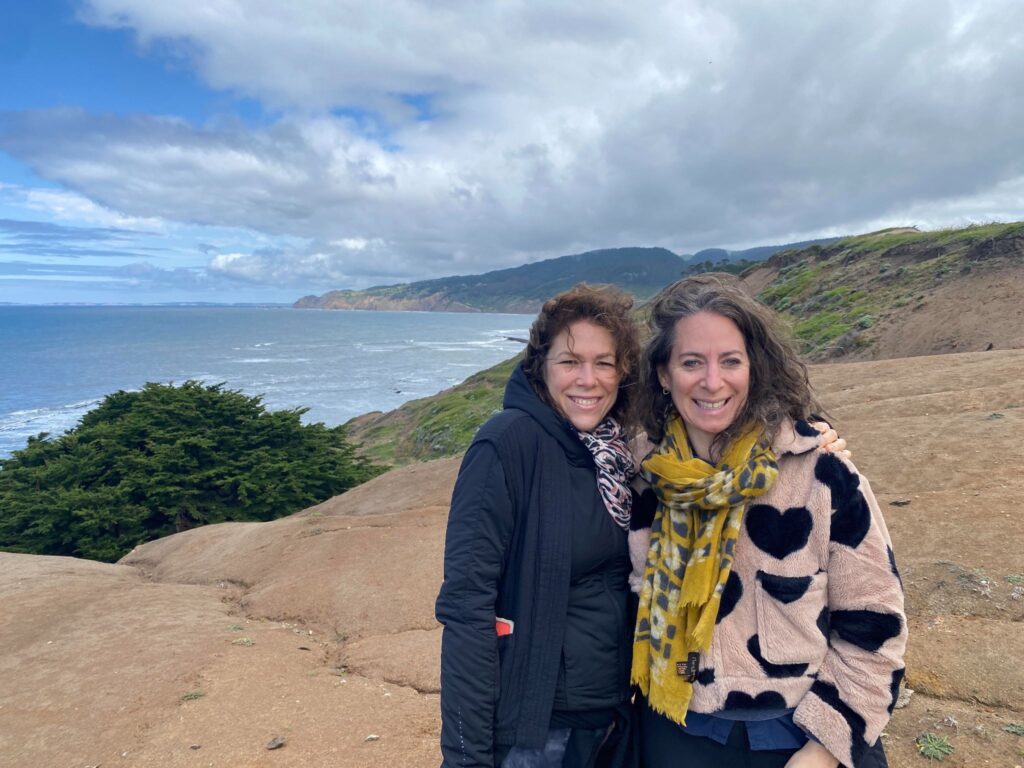
Marchand and Sobsey during their visit to Commonweal in Point Reyes National Seashore. Photo by Heather Clapp / PRNSA.
Remaking the Book
The artists decided to cultivate each of the plants featured in the herbarium in their own gardens, Sobsey in North Carolina and Marchand in Canada. Anthotypes (in Greek, antho = flower and typos = imprint), a photographic process that uses light-sensitive juices extracted from crushed flower petals, leaves, roots, and fruits, proved to be the perfect medium for their timespace, floral exploration. The pair envisioned bringing new life to Dickinson’s pressings by layering black and white negatives of her herbarium pages over paper coated with the plant pigments grown in their gardens. Through alchemy, the sun would bleach and interact with the unique chemical properties of each plant, revealing the hidden colors of the herbarium in their full vibrancy.
As planting, harvesting, and making their sunprints began, the pair experienced a steep learning curve—both as gardeners and artists. Marchand notes that gardening did not come to her quite as naturally as it did to Dickinson:
“It was a complete overhaul education, and an enormous learning curve over two years of being in touch with the plants, but in a very strange way as artists. We got to know them through their many physical properties,” explains Marchand. “Is it squishy; is it really hard to rub on paper? Does it have a smell? Is it toxic? How long does that bloom last? Once you paint it on paper, does it change color from purple to blue? So many ways that we interacted with the flowers were not traditional, as in just smelling them. They were really physically interactive, and there were many surprises.”
The plants and sun mixed to produce a rainbow of vibrant colors, often surprising. Among the 66 prints emerged hues ranging from the sweet yellow of the marigold and deep purple of the petunia to the unexpected white-gray of the poppy and hot pink of the pokeweed.
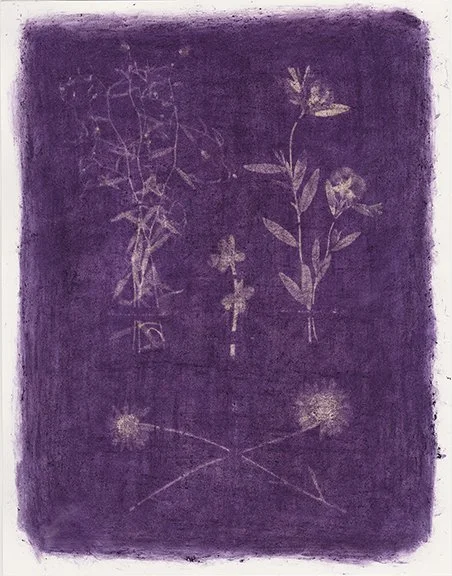
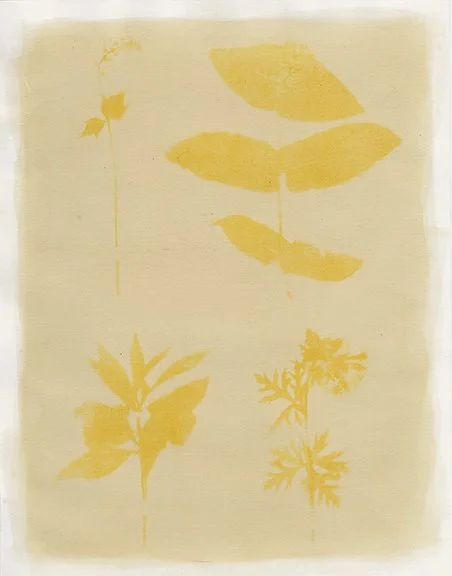
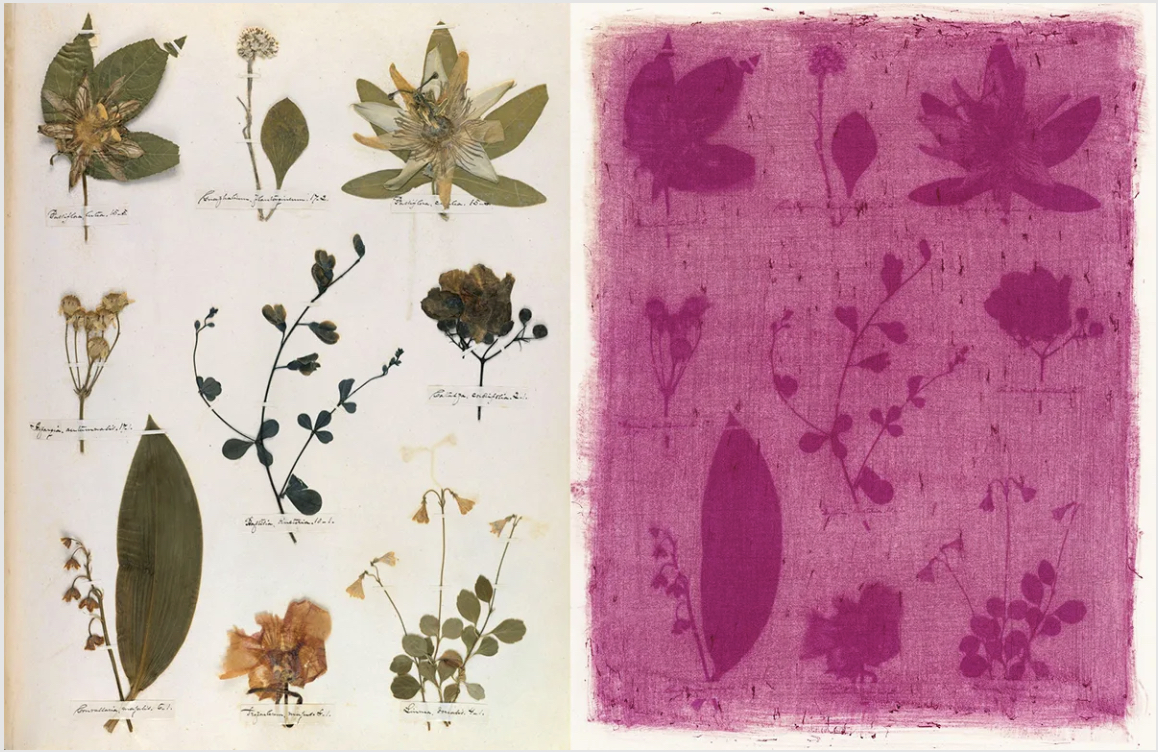
Top left: “Herbarium Plate 9 – Petunia”; Top right – “Herbarium Plate 4 – Marigold”; Bottom: “A leaf from Dickinson’s original herbarium and “Herbarium Plate 42 – Pokeweed”
“What you think you understand about a plant and the color it will produce is always changing,” says Sobsey. “When Amanda was working in Canada and I was in North Carolina, we were getting completely different results. Place matters. The season of harvest matters. The pH of the soil matters. Every variable leaves its mark. There’s always an element of surprise, and that unpredictability is part of what makes the process so exciting.”
Some of the flowers were extra meaningful to Dickinson, such as the ghost pipe—a white and translucent mushroom-like plant which Dickinson named “the preferred flower of life.” As a child, she collected this mysterious plant in the woods of Amherst. It was so significant to her that the cover of her first book, published after her death, featured an illustration of the flower. As Marchand and Sobsey experimented with anthotypes using the flower, they found that it produces an eerie gray-black hue. Dr. Kyra Krakos (Maryville University) and botanist Peter Grima (Massachusetts Department of Conservation & Recreation) collaborated with Sobsey and Marchand on This Earthen Door, including research on the ghost pipe. Krakos’ former graduate student, Senaa Mirza, found the flower contains chemical healing properties for eye ailments which Dickinson suffered from leading up to her death in 1886. Unbeknownst to her, Dickinson’s favorite plant could have possibly alleviated one of her health struggles. The pair named the piece created with the ghost pipe’s pigment The only ghost I ever saw.
The collection of prints became an exhibit and book, This Earthen Door, titled after a line in Dickinson’s poem, “We can but follow the sun.”
Printing Point Reyes’ Dualities
Since completing This Earthen Door, Sobsey and Marchand are working to extend the project to reinvigorate other botanical archives around the country. The Seashore holds a large collection of pressed plants, and Point Reyes National Seashore Association (PRNSA) commissioned them to create a piece based on the Seashore’s ecosystems. The artists collaborated with PRNSA Biological Science Technician Miriam Golding to select a pressing out of the park’s archives, choosing a branched herb with long, swooping roots: the curly-leaved monardella (Monardella sinuata subsp. nigrescens). When in flower, the plant produces clusters of lavender blooms. Three of the monardella’s tiny, oblong shaped seeds—little pockets of life—are tucked in an envelope attached to the corner of the pressing.
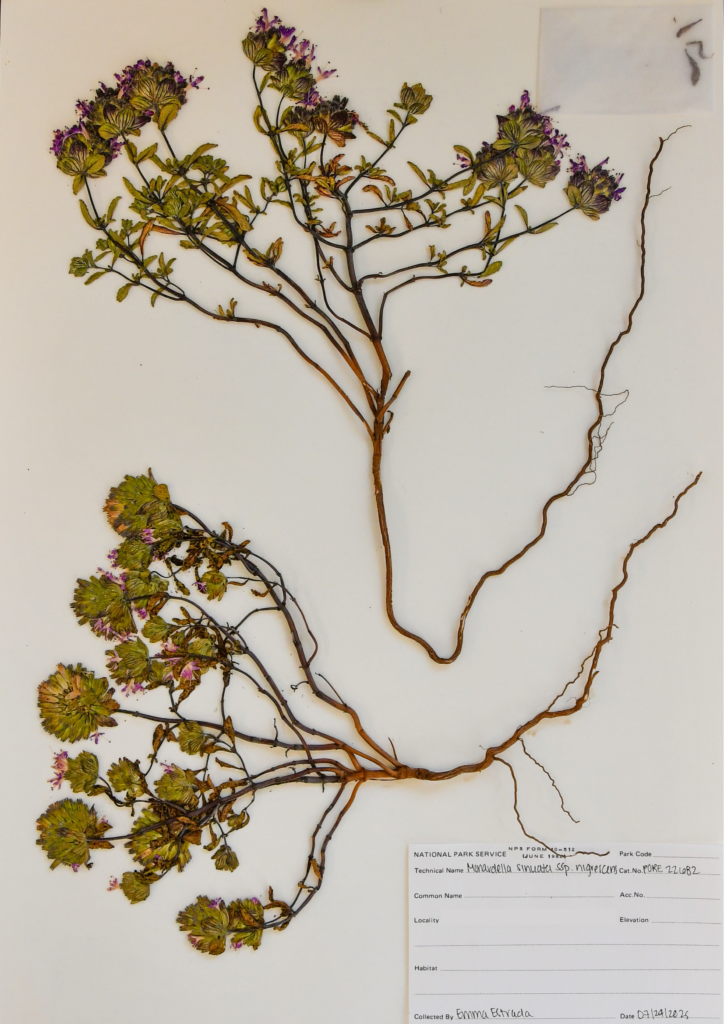
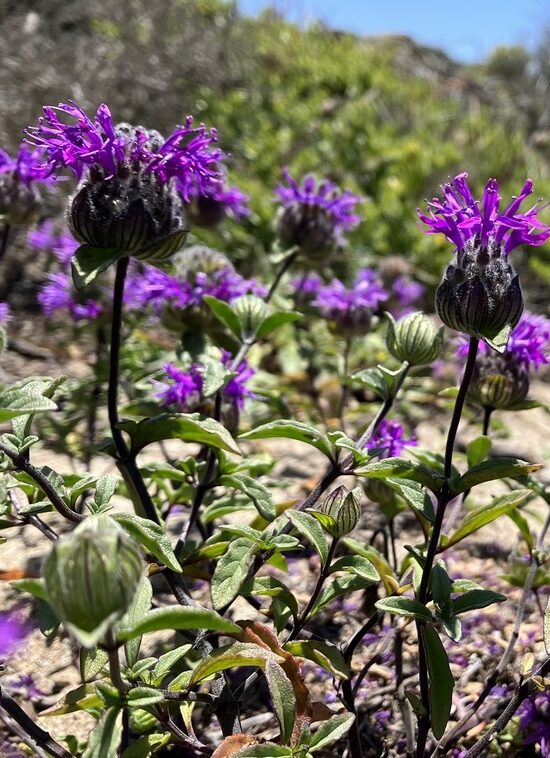
Left: The original pressing of the curly-leaved monardella kept in the Point Reyes archive. The monardella was collected and pressed by Emma Estrada in July 2025. Right: Curly-leaved monardella growing in Point Reyes’ sandy dunes. Photo by Marcus Tamura via iNaturalist.
The monardella is listed as endangered under the California Endangered Species Act, largely due to the spread of invasive ice plant (Mesembryanthemum crystallinum). Native to South Africa, dense mats of ice plant encroach upon the monardellas’ sandy dune habitat, making it difficult for them to access space and light that they need to survive. The effects ripple out to other native dune species, too—the monardella is the main nectar source for the endangered Myrtle’s silverspot butterfly. Rather than creating anthotype’s pigment out of the species featured in the archive, as they did for other pieces in the This Earthen Door collection, Sobsey and Marchand chose to create it out of the vibrant pink and purple flowers of ice plant.
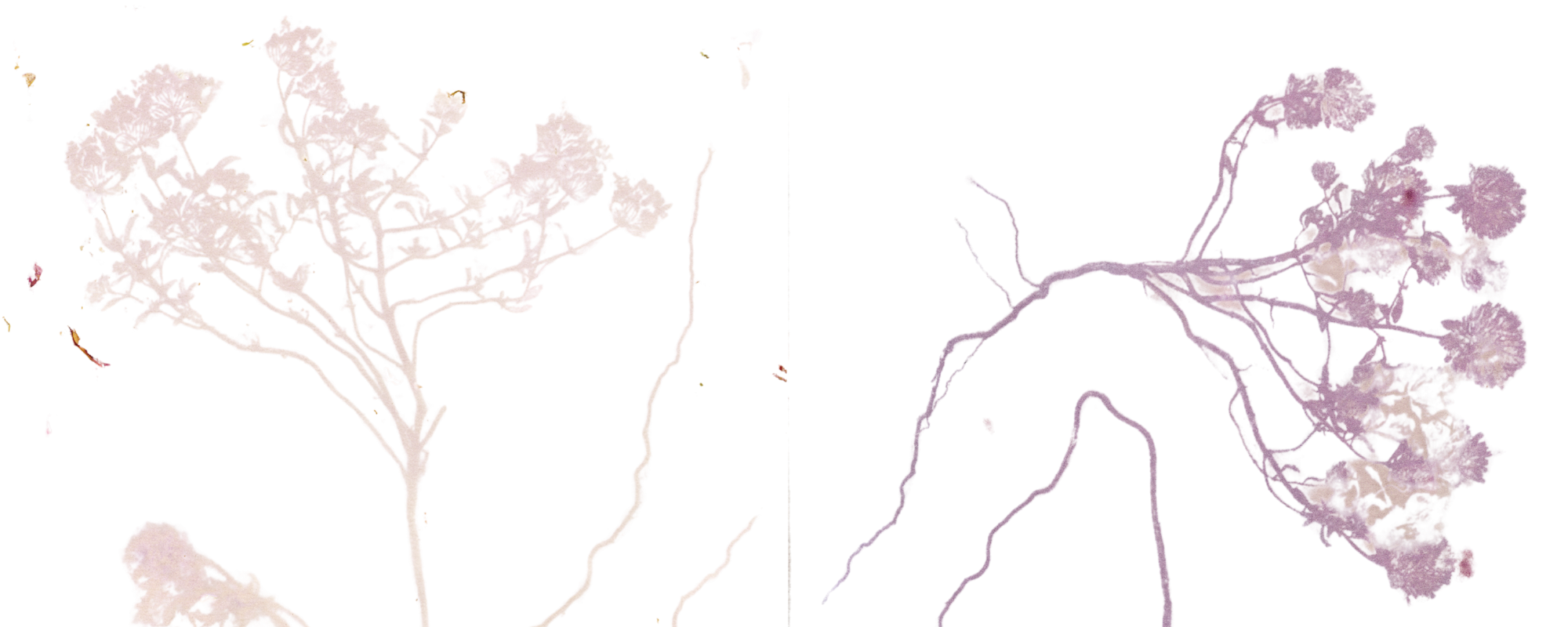
Volunteers and PRNSA staff picked two batches of ice plant from the Seashore, and shipped it to the artists. They carefully ground up the blooms with alcohol using a mortar and pestle, and painted the liquid onto paper. The two batches were harvested at different times in the ice plant’s bloom cycle; Sobsey and Marchand found that one batch produced a more pinky-purple tone, while the second produced a more pinky-yellow tone. The pair placed a black and white negative and a positive over two sides of the pigment-coated paper, creating a diptych. The left panel features a darker colored monardella (where UV light interacted with the ice plant pigment within the shape of the monardella), and on the right a mirror image in which the monardella appears lighter in color, as the sunlight was blocked from interacting with the pigment in this area.

The curly-leaved monardella anthotype created by Amanda Marchand and Leah Sobsey, exposed on paper coated with pigment from invasive ice plant blooms. The piece was revealed during a This Earthen Door gallery opening at Traywick Contemporary.
The project is a merging of many dualities: the photographic positive and negative, the two batches of ice plant, Marchand and Sobsey, the collaboration between the artists and PRNSA, and importantly, the endangered plant and the invasive plant. Sobsey and Marchand see this work as a way of invigorating conversation around the conservation of imperiled dune plants at the Seashore, such as the curly-leaved monardella, and the challenges of ice plant encroachment—all while recognizing the immense beauty of both plants.
“We paired these plants together as a way to open conversations around difficult subjects, topics that can sometimes push people away,” says Sobsey. “By creating something beautiful, we hope to invite people in first, making space for dialogue, reflection, and curiosity.”
This Earthen Door and the monardella are a call to redirect our attention towards nature, asking where Dickinson might guide us in the face of the present day’s growing environmental challenges: “The word ‘bluebell’ was dropped from the dictionary to make room for other computer-related tech words,” says Marchand. “What to learn from this: we need to direct back to nature. It’s our oxygen, it’s our food, it’s a solace, it’s a source of joy. We use it for art to communicate, to bring us together. This specific [monardella] print is a way for us to connect through nature as humans and to celebrate it.”
From Dickinson’s herbarium cased in green cloth to a tiny purple flower blooming in Point Reyes’ dunes, the touch of seemingly distant realities is incredible, indeed.
The monardella print is exhibited at Traywick’s Contemporary in Berkeley until August 15th, along with the This Earthen Door collection. On Wednesday, August 5th, Traywick Contemporary will be holding a gallery evening (no appointment necessary) from 5-7pm. From a small edition of six, the print is available through Traywick Contemporary, with a portion of each sale supporting PRNSA’s wildlife and habitat conservation work. Questions can be directed to: artprojects@traywick.com.
PRNSA regularly offers volunteer opportunities to support the health of the Seashore’s dune plants—such as the monardella—through ice plant removal. Visit our “Thursday Weeders” volunteer page for more information.
The artists invite inquiries to make site-specific portraits of place with the local ecologies.