
Otis the Mountain Lion: Keeping a Pulse on Pumas in Point Reyes and Beyond
October 7th, 2026__|__Avani Skye Fachon, PRNSA Multimedia Storytelling Coordinator
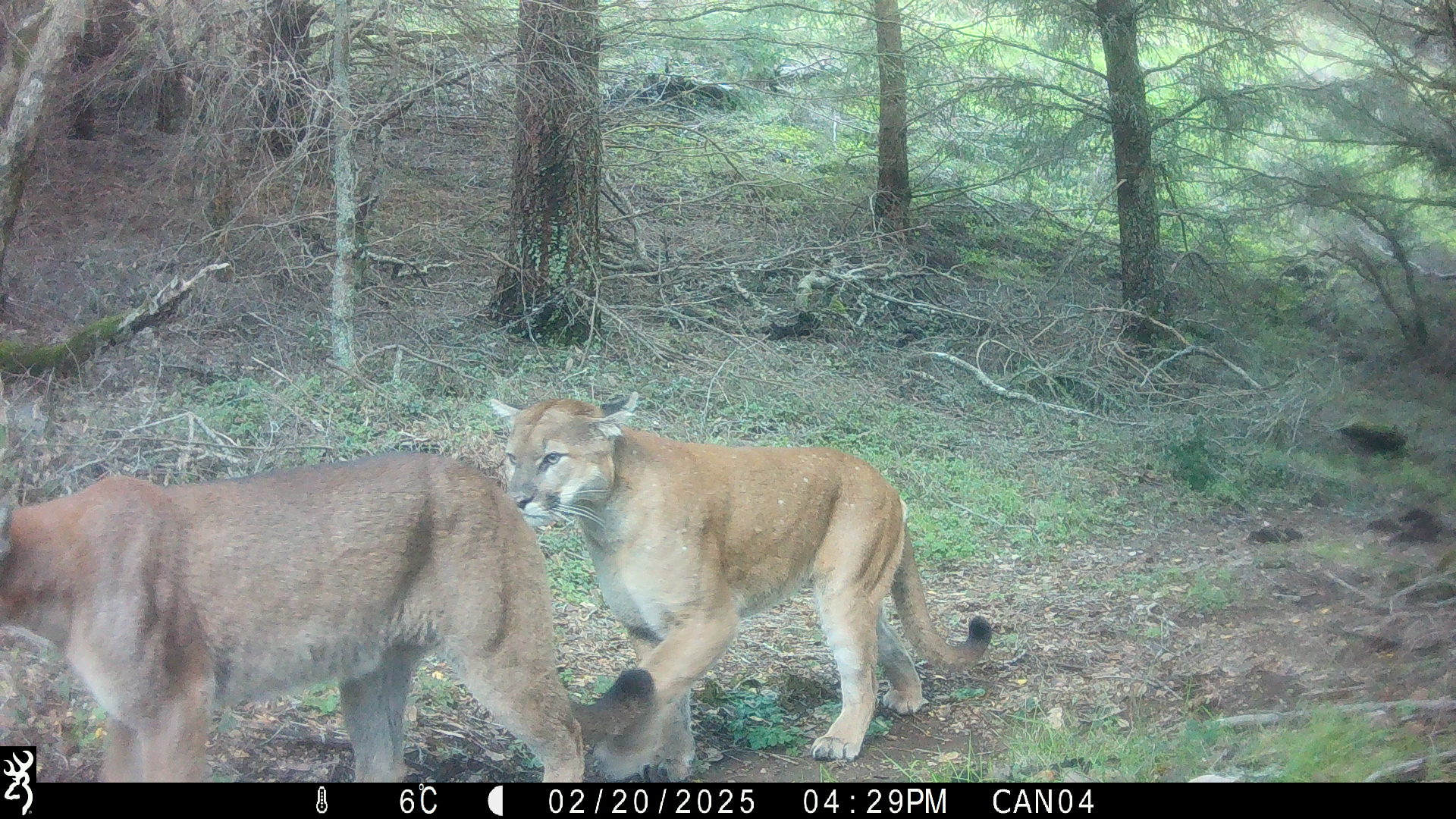
It’s midday, and a mountain lion curls up on a bed of bay laurel leaves in a Point Reyes forest. The foliage releases an herbal scent as he settles down, licks his notched coat, sighs deeply, and finally closes his amber eyes. As he drifts off to sleep, the lion’s rounded ears twitch, attuned to birds rustling and hikers chatting on nearby trails. He’s keenly aware of human activity on the Seashore’s fire roads and trail networks, but always avoids them, staying just out of sight. This is Otis, dubbed the “Uncontested King of Marin.”
Researchers at the Bay Area Puma Project (BAPP)—the first large-scale research, education and conservation program for pumas in and around the San Francisco Bay Area—first laid eyes on Otis in 2022 as he padded into frame on black-and-white camera footage playing on their computer screens. In the video, he sniffs the forest floor, his black-tipped tail held out long, before sauntering beyond the camera’s eye.
This footage was recorded on one of the many motion-sensing cameras (aka “camera traps”) placed around Point Reyes and Marin County to track pumas’ movement patterns and behaviors. A network of camera traps have monitored mountain lions in the Point Reyes area since 2007, and there are multiple scattered around forested habitats. Hikers may spot them affixed to Douglas fir and bishop pine trees with labels to inform curious passerby: “WILDLIFE RESEARCH ONGOING.” These cameras collect thousands of wildlife images each month, and when a lion is photographed, the BAPP team identifies individuals through distinct features such as coat patterns, injuries, and other unique physical traits. Every time the researchers spot a broad head, low-slung belly, and a coat flecked with grey, they know that their camera has been graced by Otis’ presence.
“We have created maps over time of lion movements throughout Marin, and we track those closely today as part of the project,” says Zara McDonald, CEO and biologist at Felidae Conservation Fund, the parent organization of BAPP. By collecting data points about lions around Point Reyes, Marin County, and the broader Bay Area through spatial tracking, modeling, and lab analyses of biological samples, BAPP is developing one of California’s most detailed databases about wild felid health, helping to better understand and support lions like Otis as they face growing challenges to their survival. BAPP’s data is complemented by research led by Dr. Quinton Martins through Living with Lions, a collaboration between All Hands Ecology and True Wild Conservation that expanded into Marin County in March 2026, creating new opportunities to understand how pumas are faring in the North Bay.
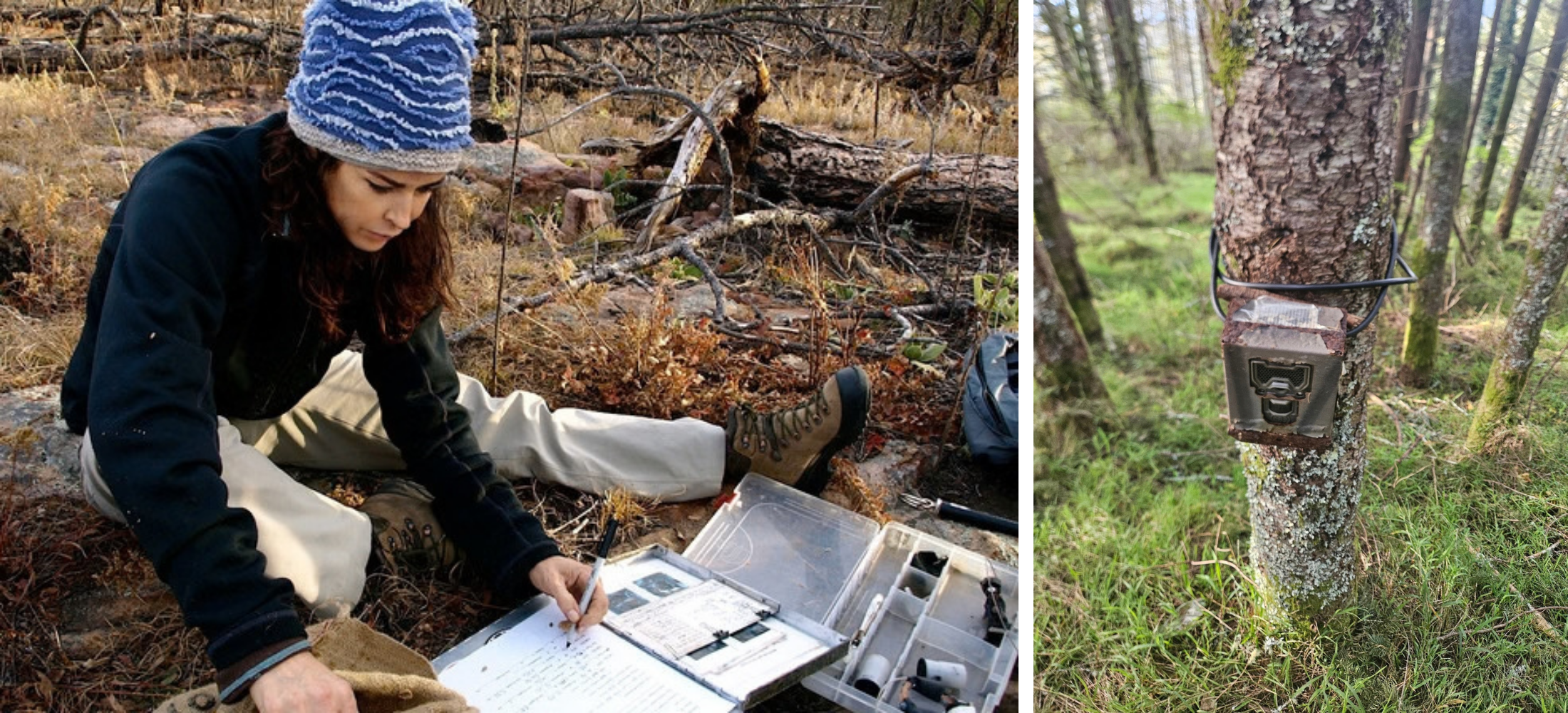
Left: Zara McDonald in the field. McDonald is CEO and biologist at Felidae Conservation Fund, the parent organization of BAPP. Photo by Brian J. Right: A motion-sensing camera used to track mountain lions, part of the BAPP’s work to develop one of California’s most detailed databases about wild felid health. Photo by PRNSA / Avani Fachon.
Plight of the Puma
Prior to European colonization, the Bay Area was home to many large carnivores. Alongside mountain lions, jaguars roamed oak woodlands, grizzly bears sauntered through forests, and wolves ran in packs. In the 19th century, jaguars were killed for their rosetted pelts and the last California grizzly bear—the state’s official symbol—was spotted. Wolves became locally extinct in the San Francisco Bay Area in the 1920s, their populations wiped out by hunting and habitat loss. As such, mountain lions are one of the last remaining large carnivores keeping Bay Area ecosystems balanced. Studies show that pumas interact with an estimated 485 different species, from the black-tailed deer that the lions feast upon to the beetles that use prey carcasses as nurseries. According to Felidae Conservation Fund and Panthera, this is thought to be the most diverse number of relationships documented for any carnivore in the world.
Pumas, too, are becoming increasingly threatened as the Bay Area becomes more urbanized. Highways, fencing, and urban development break up the pumas’ habitat into smaller patches, leaving them with little room to hunt, rest, reproduce, raise young, and feel safe. Researchers have even observed lions breeding and raising young right next to freeways, and 535 pumas were killed on California highways between 2015-2022. Though pumas purposely avoid humans, they have been forced to spend more time in urban areas—in direct view of the public—resulting in many headlines reporting lion sightings, such as in San Francisco’s Outer Sunset. Lions’ habitat is also often fragmented by agricultural land; one working hypothesis is that farmland in Sonoma, for example, may be preventing access to Marin, which hosts high quality habitat. Though Marin County is able to sustain a larger population, only about 4-5 mountain lions currently inhabit the area—including Otis.
Otis filmed on a motion-sensing camera in Point Reyes. Protected areas such as Point Reyes are becoming evermore important to protecting puma populations. Though Marin County is able to sustain a larger population, only about 4-5 mountain lions currently inhabit the area—including Otis. Video courtesy of BAPP.
Otis’ range extends across Point Reyes and the Marin watershed, which he strategically patrols to deter transient juvenile males—looking for their own territories—from establishing themselves. All mountain lions require large ranges like Otis’; individual females have territories of up to 300 square miles, while males defend territories that are upwards of 500 square miles. Females are fairly tolerant when their ranges overlap with other pumas, but males are very territorial against one another. Young males searching for home ranges of their own are especially vulnerable as they cross busy highways and agricultural lands, and some landowners (especially in North Coast where mountain lions do not have protection under the California Endangered Species Act) have depredation permits allowing them to protect herds of livestock by killing transient lions. The 2024 documentary The Path of Puma-36 follows a young lion (named “P-36”) as he journeys across Highway 101 six times, swims the Russian River, and passes through farmlands and neighborhoods in Northern California to find territory of his own.
Protected areas such as Point Reyes are becoming evermore important to protecting puma populations: “It’s absolutely essential that we have continuous patches of habitat for lions to persist,” says McDonald. “The contiguous habitat of Point Reyes is absolutely essential for one or two or three lions that are moving through there right now and using it as habitat.”
Canines for the Felines
To understand how to best support the lions, researchers must first understand their whereabouts and assess their health. Camera traps provide key location data, but getting a pulse on their physical health requires something more…smelly.
Every year, BAPP enlists the help of specially trained scent-detection dogs to sniff out mountain lion scat. These conservation dogs, trained by biologist and dog handler Karen DeMatteo and Rogue Detection Teams Co-Directors Jennifer Hartman and Heath Smith, work with biologists around the Bay Area to unlock an expansive library of biological data—from gopher frogs and orchids’ underground roots to endangered western pond turtle nests and lizard scat. Leveraging the dogs’ sniffing powers allows BAPP to study pumas without the use of more invasive and risky methods, such as capturing, sedating, and collaring lions.
“[During a typical field day,] we walk about 10k or more, just following the dog’s nose. We have a general path in mind of where we want to start and where we want to end up, but how we get there is basically up to the dog,” says Alys Granados, wildlife ecologist with the Bay Area Puma Project who takes the dogs on scat surveys. After the dog detects a sample, she logs the coordinates of the newly discovered feces, takes notes and pictures to record the quality and freshness, and separates the scat sample into bags to be sent off to various labs for analysis. From one single sample, BAPP team can extract DNA to measure genetic health, analyze cortisol levels to assess chronic physiological stress, test for heavy metal exposure like mercury, and screen for multiple parasites and pathogens.
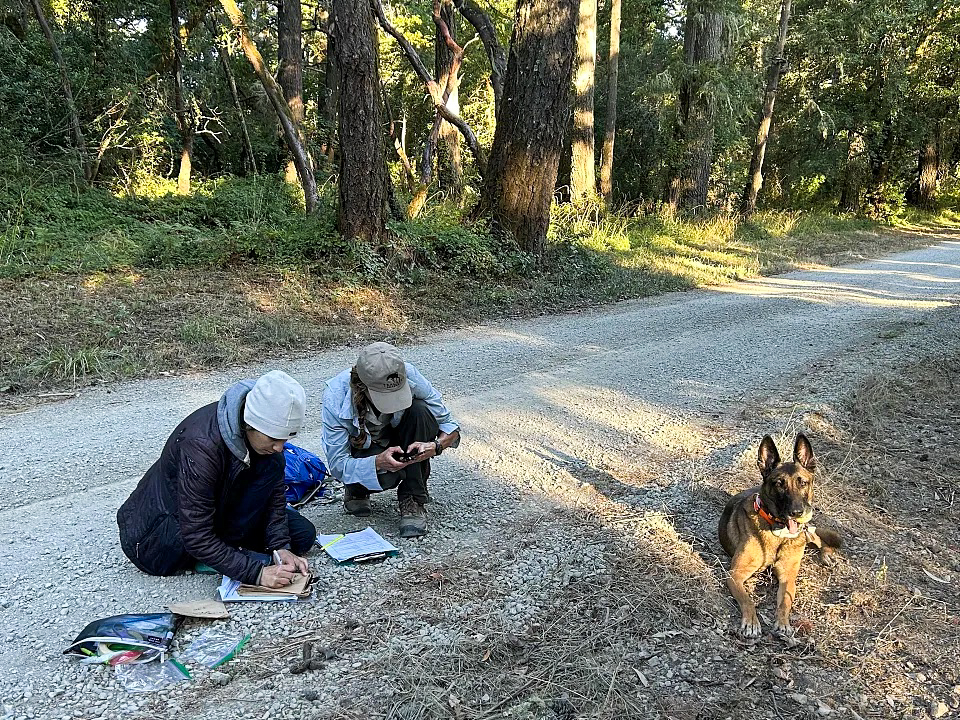
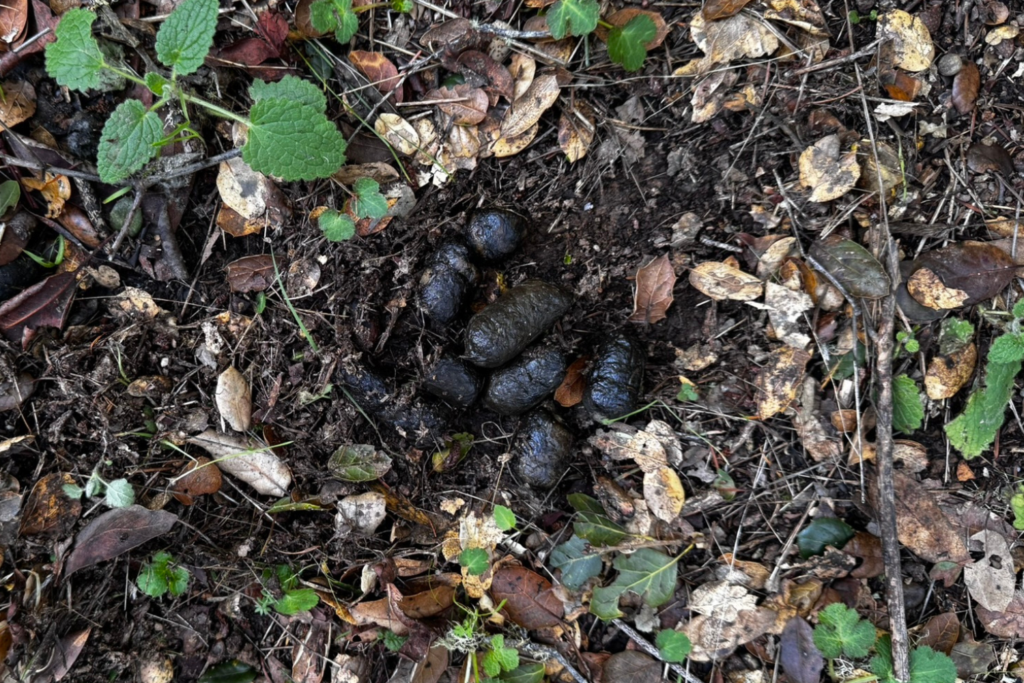
Left: Biologists Alys Granados and Karen DeMatteo record data on puma scat located by scent detection dog, DJ. Image by Courtney Quirin. Right: Puma scat. From one single sample, BAPP team can extract DNA to measure genetic health, analyze cortisol levels to assess chronic physiological stress, test for heavy metal exposure like mercury, and screen for multiple parasites and pathogens. Image by Sarah Reid via iNaturalist.
BAPP has also been experimenting with installing hair collection stations around the Bay Area—a brush or nails on which the lions can scratch themselves, leaving behind fur samples for biologists to collect. The stations are equipped with scent lures to attract the lions; BAPP is working with the Oakland Zoo to test which types of odors are most irresistible to the feline nose. Fur data unlocks a treasure trove of information for building out the pumas’ genetic and health profiles: “The information on a hair is more stable and lasts longer than in scat,” says McDonald. “We can learn about their first weaning and very detailed information about their diet over time.” McDonald and Granados plan to place some of these hair collection stations at Point Reyes in the near future.
Hope for Co-Existence
DNA samples from the scat and fur allow the BAPP team to map out which lions are related to each other. McDonald and Granados are noticing that some lions are too related. When lions are unable to move freely due to highways, neighborhoods, and agricultural lands, they have less chances of encountering unrelated individuals. “This leads to…a loss of genetic diversity, and then you start to have inbreeding. We’ve already got early signs of inbreeding in lion populations in parts of the Bay Area,” says McDonald. Inbreeding weakens the lions’ immune systems, making them more vulnerable to toxins, parasites, and diseases such as toxoplasmosis, which is spread when domestic animals (such as dogs and cats) come into contact with the pumas at the urban edge. When lions are forced to spend more time near built-up areas, they are also more likely to encounter rodenticides, which further weakens their immune systems and makes it difficult to fight off infections…such as toxoplasmosis. A feedback loop emerges: the puma’s habitat becomes more fragmented, leading to inbreeding, which in turn leads to increased susceptibility to diseases and chemicals present at the urban edge. It feels like an inescapable spiral.
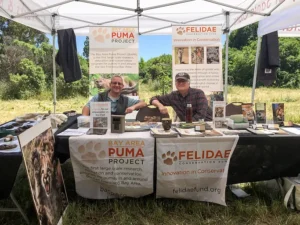
However, McDonald and Granados have hope. The data which they are collecting enriches the statewide database on pumas, providing critical information to develop habitat linkage priorities (think: wildlife crossings over freeways) and species protection plans. As of September 2026, California’s Wildlife Coexistence Program was re-established after having expired in 2024. The program will address human-wildlife conflict (on agricultural lands for example) through non-lethal, proactive methods, and deploy trained regional human-wildlife conflict staff around the state. BAPP also works to educate ranchers, students, and communities about pumas through public presentations at conferences and schools, webinars, and community science, reducing tensions and increasing understanding about their feline neighbors: “Whenever we give presentations or talk one-on-one with people, you can often tell that the information you’re giving to them is making a difference and combating misconceptions—such as that mountain lion numbers are going up or that there’s packs of them,” says Granados. “It’s really rewarding to see people be receptive to that.”
Despite all the challenges that they face, pumas like Otis still persist. “They’re an incredibly versatile and adaptable species which has enabled them to survive through all the various generations of persecution on the part of humans,” says McDonald. By working to truly understand pumas and their needs, co-existence is possible.
Have you seen a puma or bobcat? Add your observation to Bay Area Puma Project’s sightings map, which supports researchers in evaluating potential movement barriers for wildlife.
Note: As of October 14th, 2026, the reference to the Living with Lions program was added.
